Keyboard Ergonomics: Only the Split Matters
Ortholinear, eigenvalue, stabilizer, keymap, kernel. Which of these terms describe ergonomic keyboards, and which linear algebra?1
A room full of programmers can feel like a carnival of letter input technology. Wavy layouts are a dime a dozen. Keys in a perfect grid and spring loaded finger screws for 3-axis tilt adjustment? Yes sir. I remember wandering around the development floor of a previous employer, wondering who had 3D-printed their own casing.
Regardless, at the end of the day, I think 90% of ergonomic keyboard tech is misguided or placebo theater. Systematizing minds who purchase these products should direct their attention towards methods of usage and decrease reliance on technological gimmicks.
Typing Perfectly Still
The QWERTY layout with alternating spaced keys is a byproduct of 1870s typewriter constraints. Ergonomic keyboard discourse and development treats typing as a static optimization problem built on top of this base.
A rectangular grid compacts wrist deviation and shoulder spacing. Stretch the layout out slightly and curve it for a wave layout. Split them in a single housing, or move them into separate housings altogether for split.
From a static position, fingers hinge along a straight column, not a diagonal stagger. This is the origin of ortholinear or column-staggered key layouts.
A hand laid flat palm down encourages an uncomfortable degree of wrist/forearm pronation. Forcing the reversal of this pronation requires lifting the center of a split keyboard to tilt the two halves, denoted tenting.
Astute biomechanical observers will notice that when the palm is suspended in a static location in space, the range of motion of each individual finger can be isolated to an arc. Combining these arcs and delegating modifier keys to robust thumbs results in keywells and thumb clusters.
Fluidity in Movement
In the broader sphere of workplace ergonomics, there is a growing consensus that staying still is the root of postural problems. Seating advice has moved from maintaining perfect lumbar curves with soft cushioning to sit-stand desks and dynamic movement-based lumbar support. In other words, no single posture is ergonomic over the long run, and we want to encourage continuous flexibility.
The way to apply this same logic to keyboard ergonomics is to free your hands and perform the "hover". Instead of touch-typing with a static palm and each finger mapped to a specific subset of keys, float your hand in space and type with whatever finger feels natural.
A suspended hand naturally cups inward, so forearm pronation and finger length differences get absorbed by hand articulation. The thumb's base joint, augmented by hover range of motion, does fine reaching modifiers without a dedicated cluster (though clusters are still nice). We no longer need tenting, which exists mostly to compensate for the bad habit of resting your wrists in the first place.
Keywells and ortholinear layouts go too: a floating hand has no fixed geometry to fit, and a sculpted shell actively constrains where your hands can go. Worse, the sculpted shell of a keywell board actively constrains where your hands can go, reducing variability.
Hovering allows us to drop every innovation except the split. Wave layouts and single-housing splits carry the same lock-in problem as a keywell. I advocate for only a full split, the keyboard equivalent of a sit-stand desk and a firm but supportive chair. Slide the halves wherever you want throughout a typing day.
Paying for Geometry
To be fair, there is good-faith research on the static-optimization knobs. A series of within-subjects studies converges on roughly 14 degrees of tenting, 15 degrees of opening angle, and a key surface within 4cm of elbow height as the geometry that minimizes ulnar deviation and forearm pronation without dropping WPM.
The catch is that hovering and repositioning are awkward to operationalize in a lab and basically absent from experimentation. Seating ergonomics had this same problem for years before longitudinal evidence pushed the field toward move around and stand sometimes.
Even granting the labs' optimum geometry, the studies don't ask what it costs to get there. I performed an informal cold-switch experiment among a group of high-output writers, asking them to type on a full-height mechanical keyboard, a flat fully split keyboard, and a tented split keywell board.
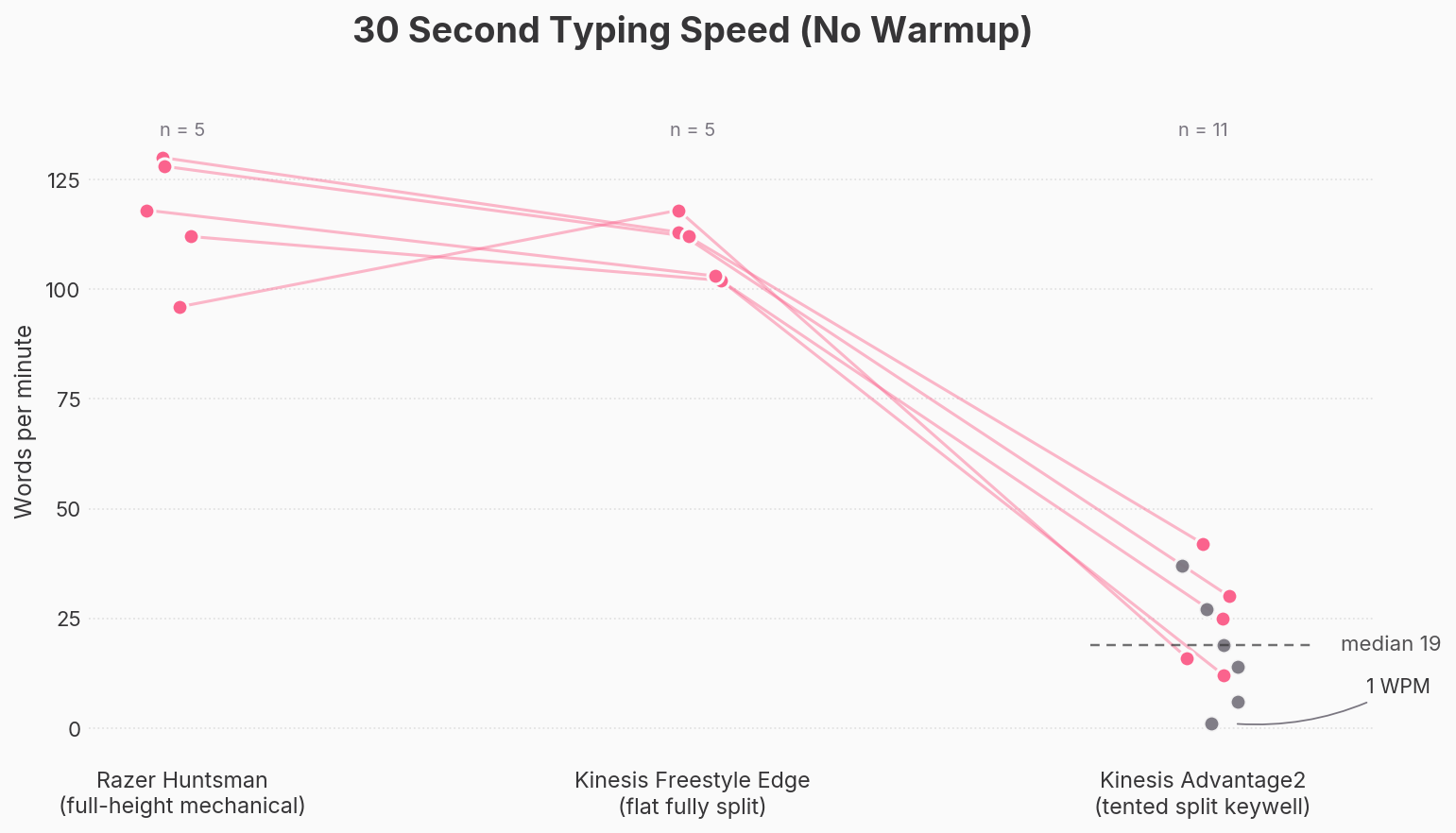
Switching to a flat split keyboard seems to incur insignificant accommodation costs. The tented keywell, on the other hand, drops the median typist to 17% of baseline with a 31% ceiling. Of course, this was sans warmup, and typists acclimatize to new keyboards over time. Nonetheless, it seems a bit insane in the membrane to drop $400 and weeks of unpaid retraining on a keyboard whose value prop is "less pain". Some might call it performative.
If you already own one, don't throw your beloved Ergodox in the trash. For us lesser mortals, hovering over a regular old split is probably enough.
Better yet, you could just type less altogether, and start dictating yesterday.
ortholinear: keyboard, eigenvalue: linear algebra, stabilizer: keyboard, keymap: keyboard, kernel: both↩