One Big Monitor, Wherever You Go

I want to sear my retinas with information. I fear a physical substrate of pixels bottlenecking the transmission of bits to my brain.
The last firm I worked at furnished me with eight monitors. My monitor at home is curved at an ergonomic radius and has the diagonal measurement of a reasonable TV.
That makes it all the more disappointing when I travel, reduced to my laptop, a screen the size of a sheet of paper.
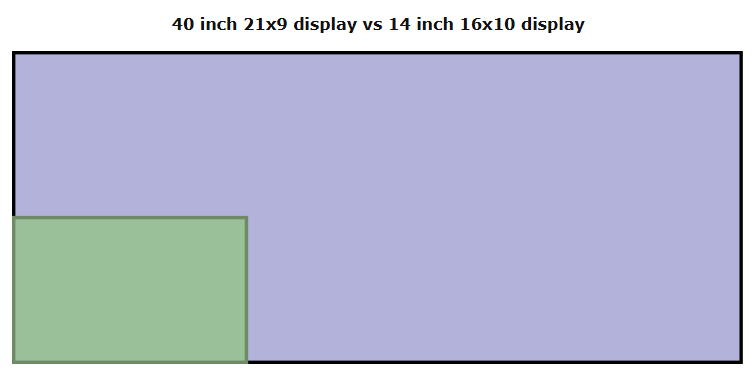
In this post I will argue that supply chain and technological trends have converged to the specific optimum solution of judiciously buying 27-inch 1440p IPS monitors when traveling for work.
Utility
ergonomics
It's probably fine banging out a couple of emails on my laptop but I don't want to end up hunchbacked, with RSI and myopia from twelve hours of laptop use a day.
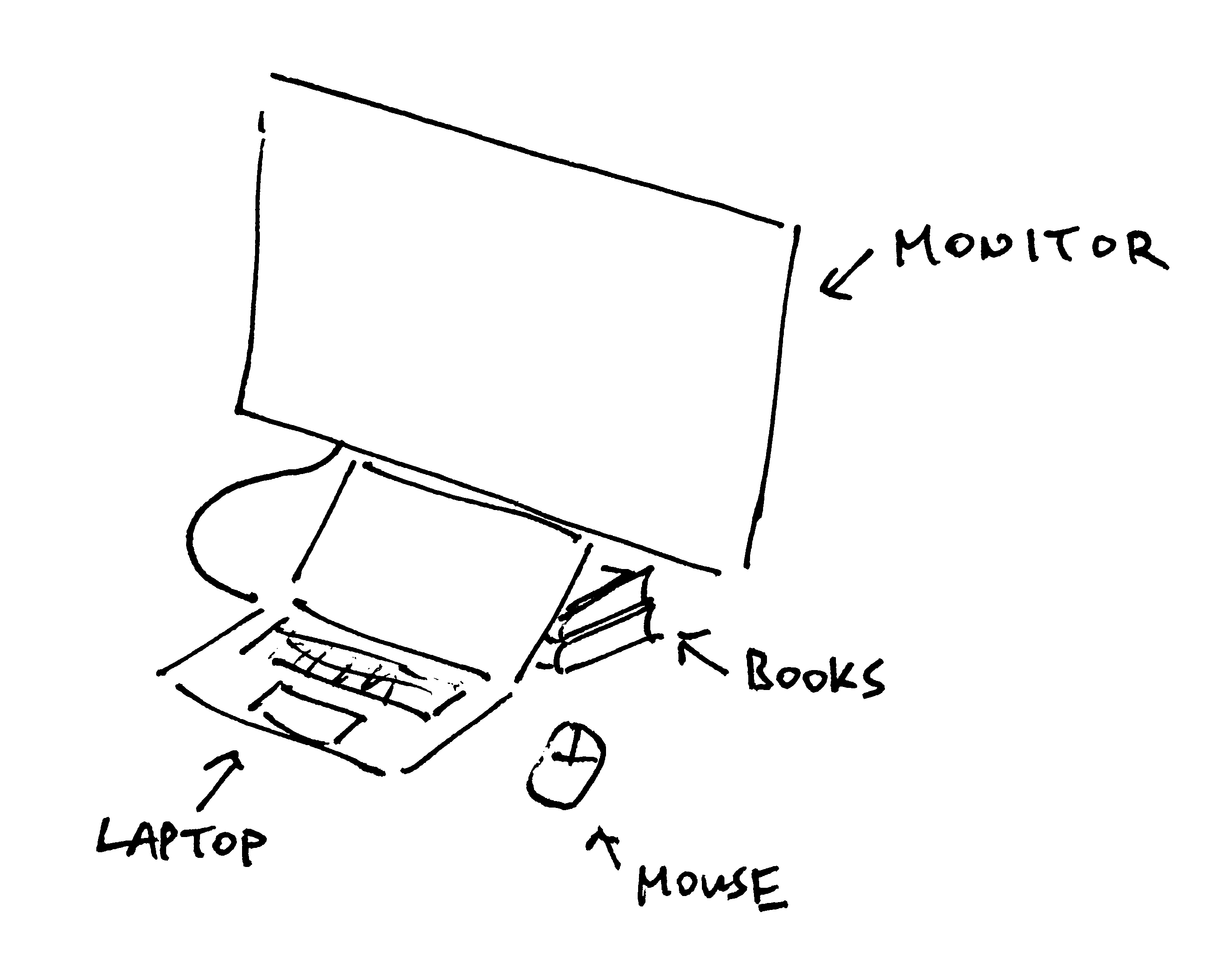
Every main ergonomic issue associated with using a laptop can be trivially solved with an external monitor and a mouse.
- Elevating the monitor on a stack of books or a sturdy box allows the neck and upper back to be in a relaxed viewing position.
- Using an external mouse prevents RSI from trackpad usage.
- Separating the keyboard and mouse allows better shoulder spacing.
- Larger display allows more distance between eyes and screen.
- IPS displays have good color accuracy, contrast, and viewing angles.
27 divided by 14 is about 4
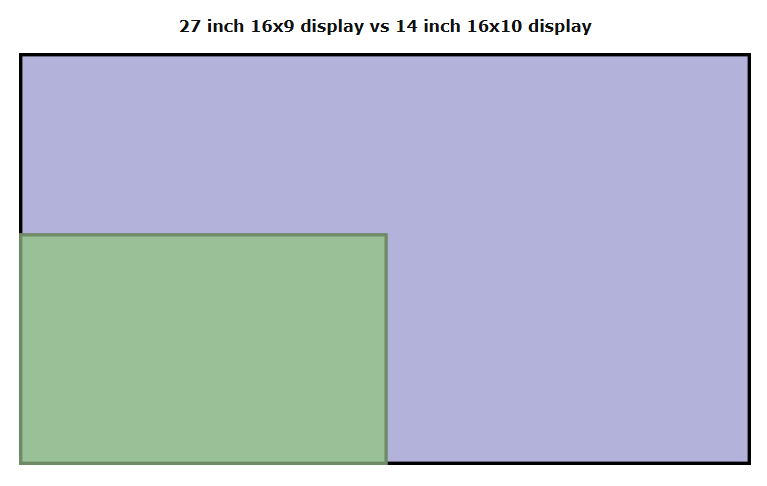
Roughly, by surface area.
So much room for activities!
A 27-inch display is enough to comfortably read full pages side by side. Ambitious multi-taskers can separate their screen into thirds or quarters or whatever the heart desires. Can you imagine four proper windows at once on a MacBook?
Fun fact! A 27-inch 1440p display allows you to simultaneously watch nine 9-inch 480p videos!
Cost
one benjamin
As of the time of writing of this post, April 2026, basic 27-inch 1440p IPS displays are readily available in the US for under $100.
How much do you value your time? If your work trip is going to cost several thousand dollars, if you wouldn't bat an eye at spending $100 on food or transportation, why should it be a big deal to spend $100 on a multiplicative tool for productivity?
Moreover, a monitor is not a disposable good - the majority of the retail price can be trivially recouped by selling it.
box and the panel, commodity convergence
The consumer need for larger and larger TVs has advanced the forefront of LCD panel manufacturing technology. Computer monitors are a trickle-down recipient of these advances.
However there are fixed non-panel costs associated with monitor manufacturing which remain roughly constant across monitor sizes. For example:
- signal processing equipment
- power supply
- housing, stand
- packaging, shipping
Below: Lowest pricing for reputable IPS monitors on Amazon.com US:
| 22" | 24" | 27" | 32" | |
|---|---|---|---|---|
| 1080p (FHD) | 65 | 75 | 80 | |
| 1440p (QHD) | 85 | 100 | ||
| 2160p (4K) | 140 | 150 |
Panel costs at 27" 1440p are low enough that stepping down to 24" or 1080p won't save much money because non-panel costs remain similar.
Stepping up beyond 27-inch 1440p involves higher 4K pixel density, where panel yield takes a substantial hit and prices shoot up.
Optimality

Am I stuck in the past? Is it so absurd? I relate to the cyborg secretaries above who live in a centuries-ahead dystopian fiction but still look at a rectangular slab ahead of them, albeit translucent. I want a headset that shows me a virtual display the size of the moon. I want a brain-computer interface that projects information straight into my neurons.
Who am I to instruct you what monitor to buy in the here and now?