Piezoelectric Bagworm Silk
In the same way that Mercedes advertises F1-derived electric AMG superchargers or Omega advertises the Speedmaster went to the moon, tennis racket manufacturers release new products every year with extravagant claims.
However, while other consumer industries bend the truth, the racket industry smashes the truth in half.
The best tennis players in the world play with plain graphite rackets. These rackets are painted to look like retail products, but include precisely zero of the materials in this post.
Let us also blur the lines of truth and fiction! Which of these technologies were actually advertised? Answer key in footnotes1
Piezoelectric Fibers
Head Intellifiber (2001)
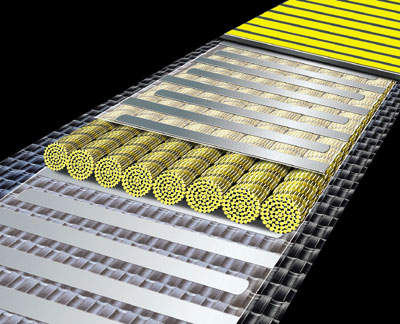
Co-developed with a MIT Aerospace spin-off, piezoelectric ceramic is extruded into thin fibers and wired into the throat of the racket. Upon impact, electricity is generated, which is routed to a chip in the handle and sends electric impulses back out of phase with the impact to stiffen the frame. The entire system is self-powered, and response time is less than one millisecond.
Aerogel
Dunlop Aerogel (2007)
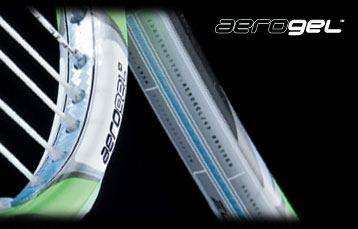
Silica aerogel is 99% air by volume and originally developed for NASA. It is nicknamed "frozen smoke." Aerogel inserts are embedded at 10, 2, 5, and 7 o'clock positions to increase stiffness without increasing racket weight. Later iterations were combined with Dunlop's 4D braiding technology, which directed forces from non-aerogel sections towards the inserts.
Diamond Nanoparticles
Babolat Syntex (2008)
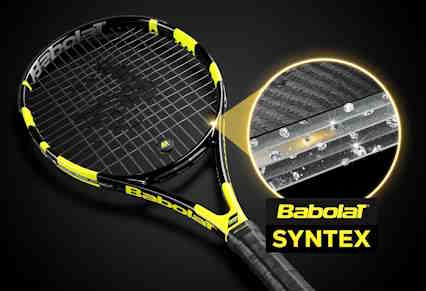
Synthetic nano-diamonds are produced by detonation synthesis and dispersed into the epoxy resin matrix used for graphite lamination. The actual volume of nano-diamond per frame is less than 1% of resin weight but leads to a substantial increase in interlaminar shear strength, as the carbon nanoparticles bond with carbon graphite on a molecular level. Advertised as "diamond crisp ball response"
Volcanic Rock
Wilson BLX (2009)
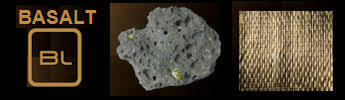
Crushed volcanic rock is harvested and melted at 1400 °C, then extruded through platinum nozzles into continuous glass filament. The fibers are woven longitudinally and crosswise with carbon composite, which is claimed to filter vibration like "noise-canceling headphones" and provide "the perfect feel".
Non-Newtonian Polymer
Head d3o (2010)
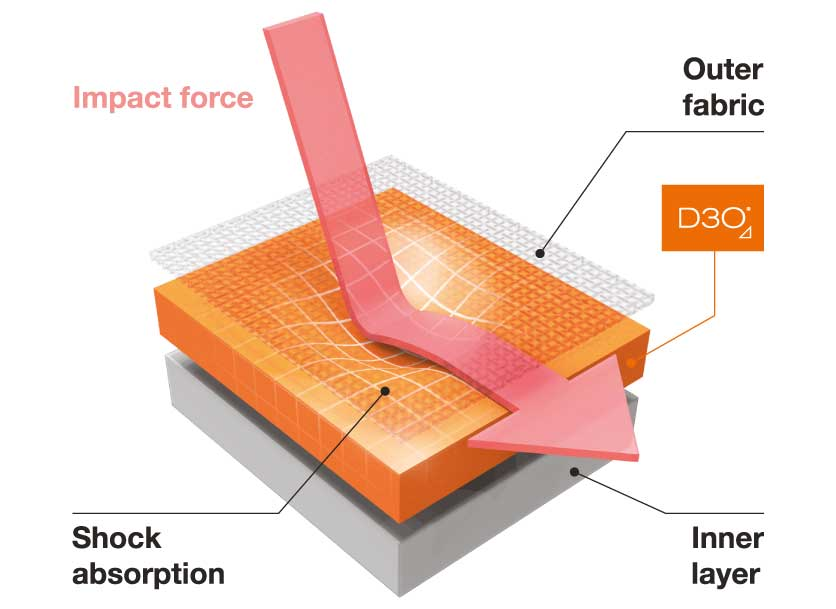
Rate-sensitive shear thickening polymer, originally developed for impact protection use cases, is engineered into solid foams. Individual molecules flow freely under slow stress but lock together under a sudden impact like Oobleck (a suspension of corn starch in water). Claimed to stiffen on hard shots for power but stay soft on touch shots for feel.
Shape Memory Alloy
Yonex Recalloy (2015)
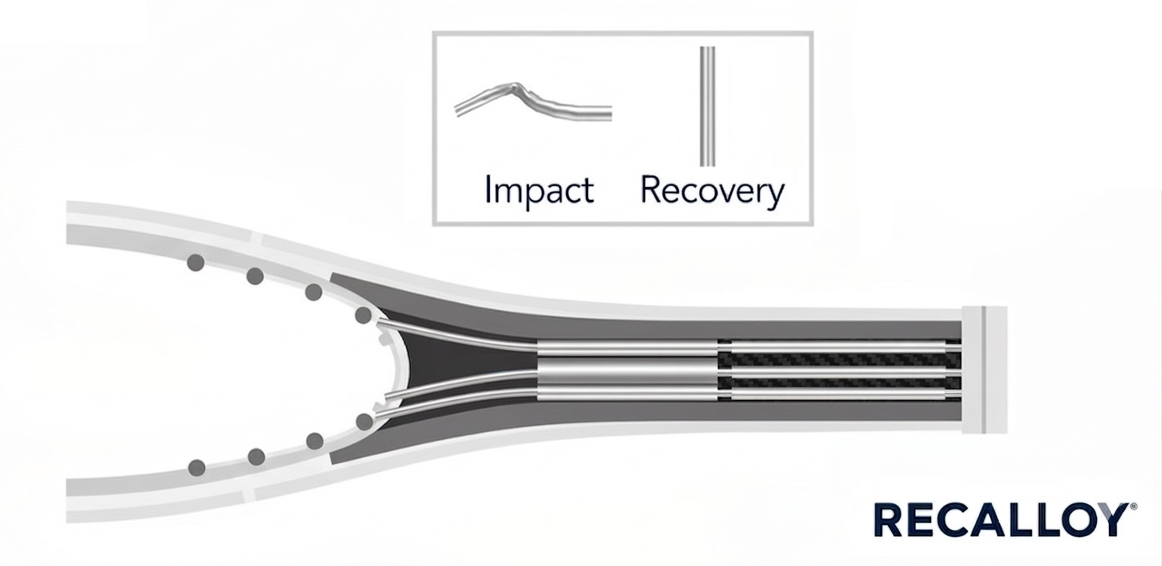
Nitinol (nickel-titanium alloy) wire segments, traditionally used in automotive actuators, are integrated into the racket throat. Unlike other shape memory alloys, nitinol is superelastic at room temperature and does not require periodic heat activation. Marketed as providing energy return proportional to the strength of the opponent's shot, "remembering the power" and returning it to the player.
Fungal Thread
Tecnifibre MWeave (2018)
Developed in conjunction with a French biomaterials startup. MWeave is woven from the mycelium (root-like fibers) of fungus grown on agricultural waste substrate. The core structural biopolymer in mycelium, chitin, is also present in crustacean shells. Claimed to provide 8% dampening improvement with 1% weight saving. Marketed as the first "bio-composite" racket with sustainably derived technology.
Bagworm Silk
Yonex Minolon (2025)
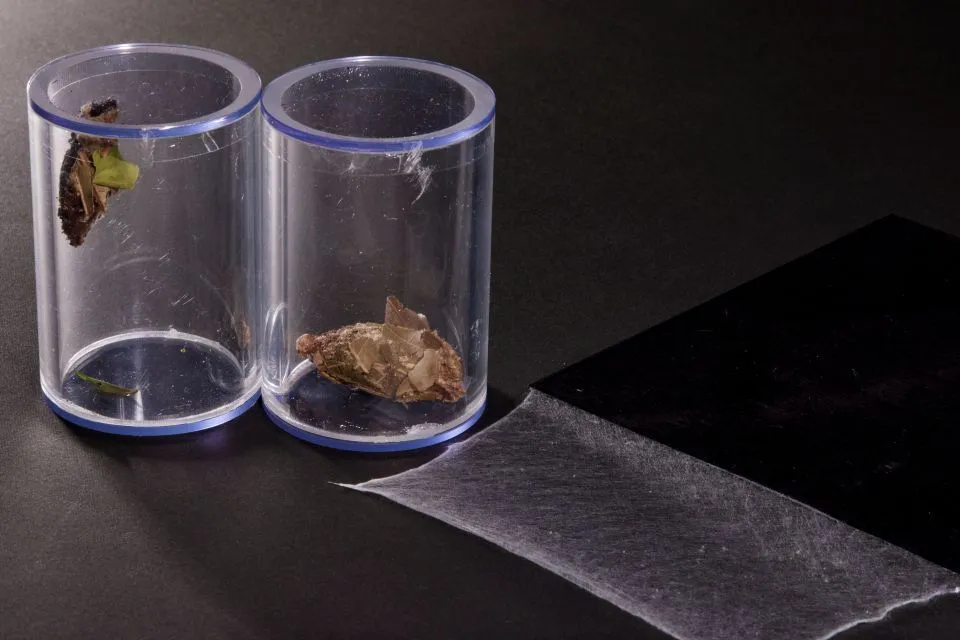
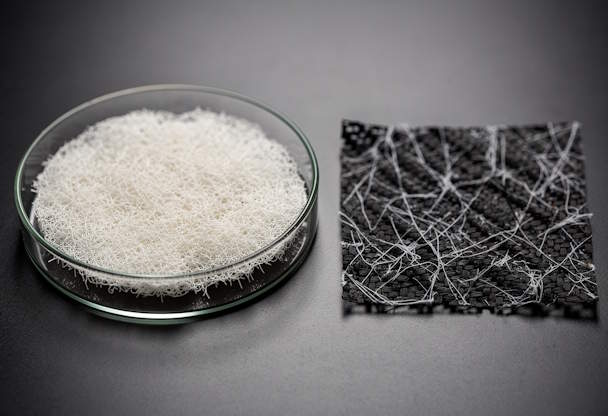
Named after "minomushi", Japanese for bagworm moth larvae. Bagworms spin silk continuously from birth, unlike silkworms, and can be harvested non-lethally via indoor breeding. The material is pressed into a non-woven sheet of randomly overlapping fibers, which are then laminated between resin-impregnated graphite. Claim to provide 6% vibration reduction versus Yonex's prior carbon nanotube membrane dampening.
Graphite
Every Modern Racket (1980s-Now)
Curiously, none of the above materials can be found in a racket purchasable today (except for bagworm silk, which has only been around for a year). Also curiously, the vast majority of players on the professional tour play with nearly pure graphite rackets, often based on shapes (molds) from years or decades past.
The only important part of a racket frame is resin dipped graphite (carbon fiber prepreg) wrapped into a hollow hoop with a handle. It turns out that biomechanically friendly tennis rackets tend to be within a certain range of weight/stiffness/vibration-resistance, and commodity graphite construction can easily be tweaked to span the desired parameter space.
Having run out of utility-based options to price discriminate the upper end of the consumer market, manufacturers have spent the last few decades gaslighting consumers into thinking that bagworm silk will improve their game.
piezoelectric fibers: REAL, aerogel: REAL, diamond nanoparticles: FAKE, volcanic rock: REAL, non-newtonian polymer: REAL, shape memory alloy: FAKE, fungal thread: FAKE, bagworm silk: REAL, Graphite: THE REALEST↩