The Racket Arm Has Seven Degrees of Freedom
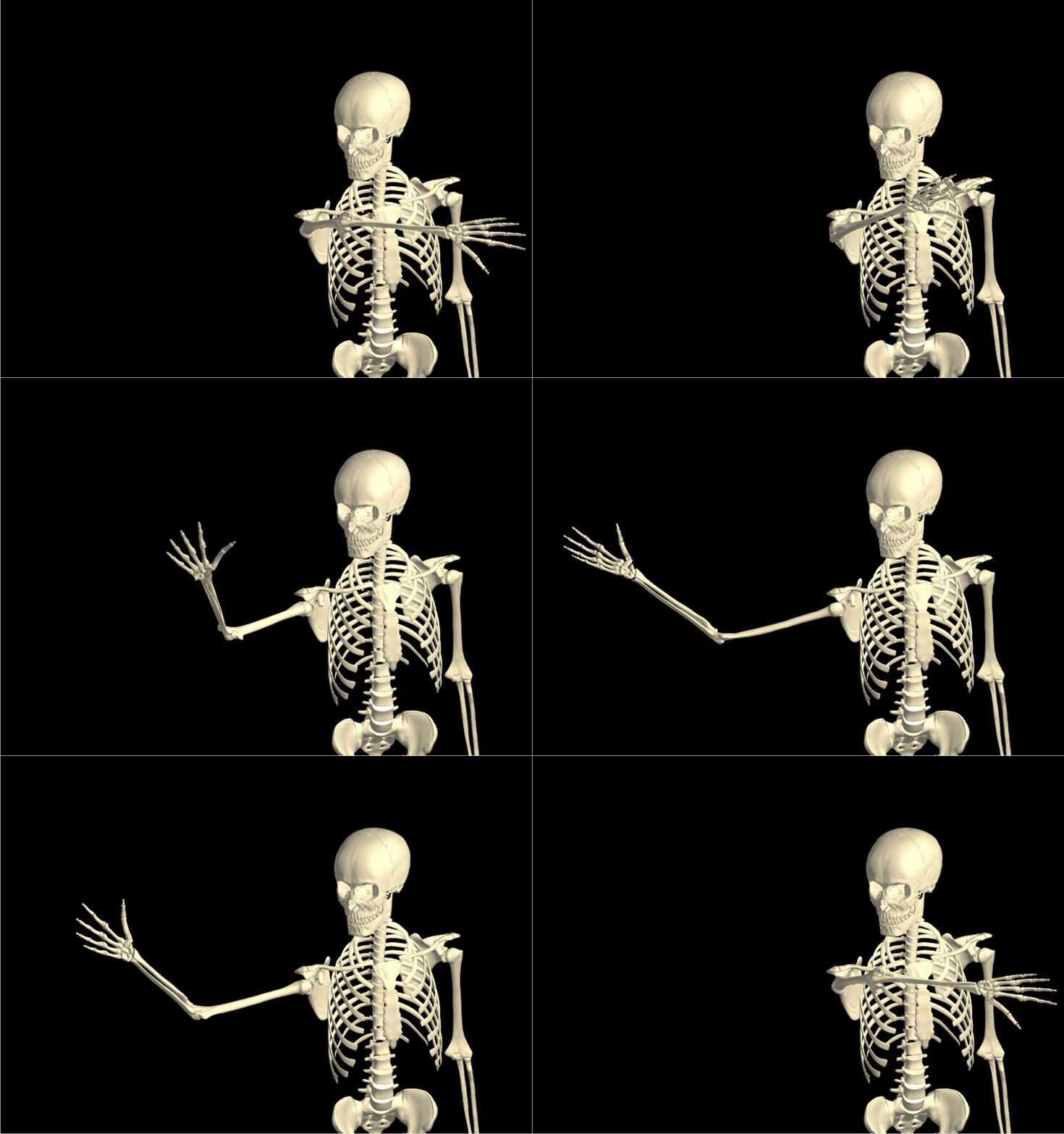
"Use your body and keep your arm loose!"
"The serve is like throwing the ball up!"
"The defensive forehand is more about the wrist!"
Coach, what the fuck does that mean?
The racket arm has seven degrees of freedom. I am here to convince you that they matter.
Specifically, I want to convince you of three things:
- Explicit kinematic knowledge helps adult racket sport learners
- The racket arm has seven DoF, and you can learn them by the end of this post
- Three rotational DoF are the primary racket sport power generators
Disclaimer: I am an adult who has learned tennis, badminton, and squash to a competent recreational level. I am not a doctor, coach, orthopedist, or sports scientist. Don't sue me if you blow your arm in half trying to bend it the wrong way.
Sportsball for the Shape Rotator
Carlos Alcaraz, Viktor Axelsen, and Mostafa Asal learned every stroke in their arsenal from 10,000 reps as a child, week in and week out. That is implicit learning - learning without conscious awareness, stored in muscle memory and applied automatically.
You (and I) and they are not the same. We don't have time for that shit. We need a degree of explicit learning, where we have conceptual declarative knowledge of a motor skill.
A primary failure mode of the implicit approach for adults is that the number of repetitions is not enough for purely intuitive kinematic learning. By the time we come back from a multi-day or multi-week hiatus, we have to derive from first principles the motion, because the kinematic memory has already been forgotten.
You might be a bit skeptical. Aren't sports about learning motor skills intuitively?
Well, I brought the receipts. In practice, the literature says that implicit learners tend to choke less, because they don't need to think as much.1 However, explicit learning is more helpful in new situations and for self-correction.2 In addition, people with larger working memory capacity, and a preference for systematization, benefit from explicit learning.2 Sound like you?
The academic recommendation is to have explicit learning "interventions" but solidify knowledge of technique via implicit learning.2
In plain English, in order to actually be able to produce a stroke in competitive situations, we're talking about practice. However, when learning strokes, it is helpful to think about the biomechanics, joints, and degrees of freedom.
And so, let us develop the vocabulary for explicit learning...
The Magnificent Seven
Alphabet, Amazon, Apple... Oops. Sorry. Wrong blog post.
As follows is a useful seven-degree-of-freedom control model of the racket arm, but your arm isn't made from servos. Real shoulder mechanics include a few more partial degrees of freedom, as well as coupling between the axes. Don't @ me.
(images from 29 FR 6718 US Veterans Affairs guide for disability rating)
1. shoulder abduction/adduction
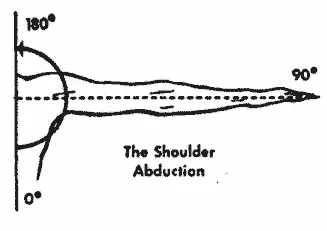
Raise your arm out by your side. Congrats, you've abducted! On the way down is adduction.
2. internal/external shoulder rotation (power!)
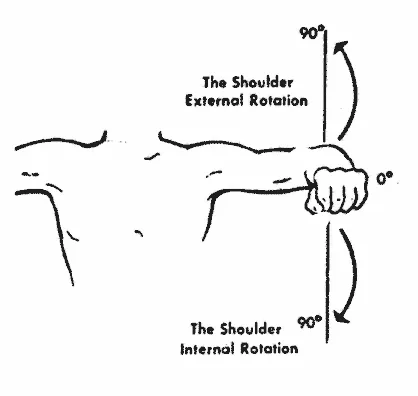
Rotate the arm around the long head of the humerus. Treat the humerus (bone between the bicep and tricep) as an axle and spin it. For the right arm, internal shoulder rotation will be counterclockwise.
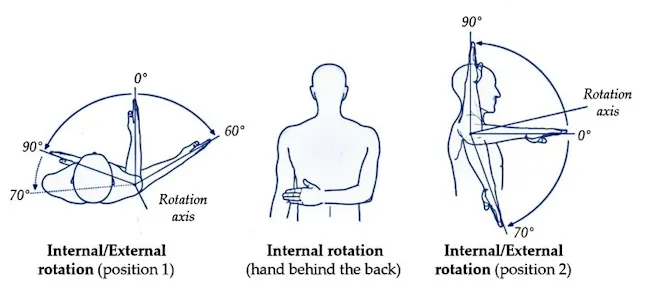
Rotation in neutral (position 1 in the diagram above) occurs when the arm is set by the side (adducted). Rotation in abduction (position 2) occurs when the arm is already 90 degrees abducted. Referenced to the right arm, internal is counterclockwise and external is clockwise.
3. shoulder flexion/extension (power!)
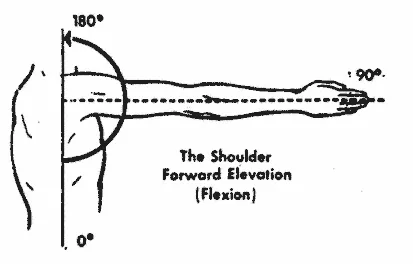
Raise your arm out in front of you. Congrats, you've flexed! On the way down is extension.
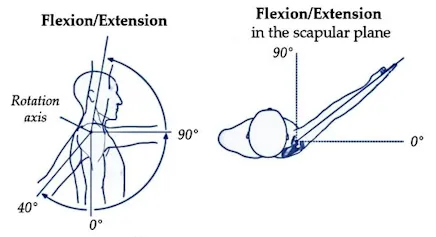
Flexion and extension in neutral occur when the arm is adducted. Flexion and extension in the scapular or horizontal plane occur when the arm is abducted. Referenced to the right arm, flexion is counterclockwise and extension is clockwise.
4. elbow flexion/extension
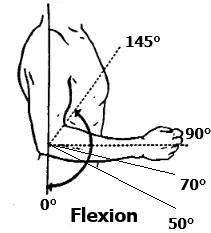
Simple joint do one thing. Elbow bend flexion. Elbow straight extension.
5. radioulnar pronation/supination (power!)
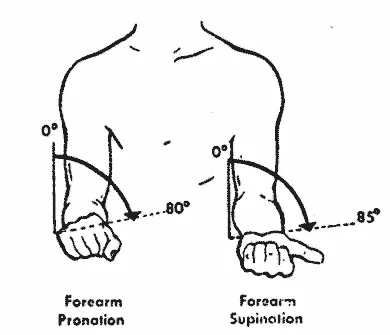
I'm cheating slightly - pronation and supination actually occur at the radioulnar joint near the elbow, but the visible effect is at the wrist. Hold your arm out, palm down. Rotate your forearm so your palm faces up. Congrats, you've supinated! Palm back down is pronation.
6. ulnar deviation/radial deviation
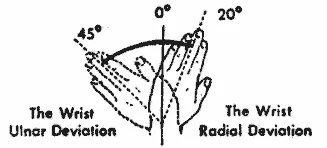
Place your right hand palm-down on a table. Keeping your wrist fixed, sweep your hand clockwise (towards thumb) - that's radial deviation. Counterclockwise (towards pinky) is ulnar deviation.
7. wrist flexion/extension
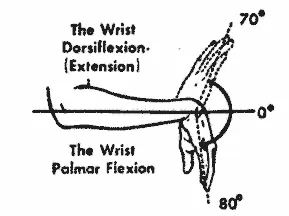
Hold your arm out, palm down. Hinge your wrist and raise your hand towards the ceiling - extension. Drop it to the floor - flexion.
The Rotation is the Powerhouse of the Stroke
You might have noticed extremely subtle foreshadowing above where 3/7 degrees of freedom beget a (power!) indicator. For power-based strokes, most force is generated from the large muscles in our trunk rotating the core.
How does that rotational motion make its way towards the racket? This process is often called the kinetic chain, and the technical term is proximal-to-distal sequencing (near-to-far order). When a proximal segment like the trunk decelerates, that energy transfers to accelerate the next segment outward.3 Each joint in the chain adds its own rotation, and velocity accumulates as you move distal.
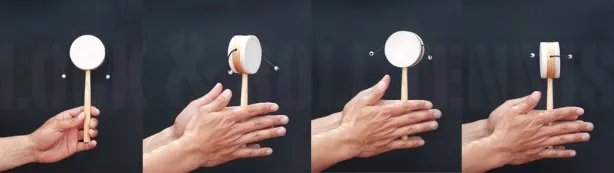
The little monkey drum toy up above illustrates why the internal/external rotation, or flexion/extension of the shoulder is the main proximal transmission mechanism for rotational motion.
Try standing up and holding your arms out in non-abducted (elbows by side) position with elbows bent. Then spin your core, and you will achieve neutral internal and external shoulder rotation at a slight lag to core rotation.
If you instead abduct and straighten your arms (holding them straight out by your side), then spin your core, you will achieve shoulder flexion/extension on the horizontal plane at a slight lag to core rotation.
One step more distal in the sequence is pronation or supination of the radio-ulnar joint. When the elbow "locks out" at full or near full extension, the angular momentum from shoulder rotation has to go somewhere.
Hold your arm out to your side, abducted and with an extended elbow. This position exactly aligns the axes of shoulder rotation and pronation/supination. Perform abducted internal shoulder rotation and flexion in the horizontal plane. You will find that angular momentum will naturally transfer into pronation of the forearm:
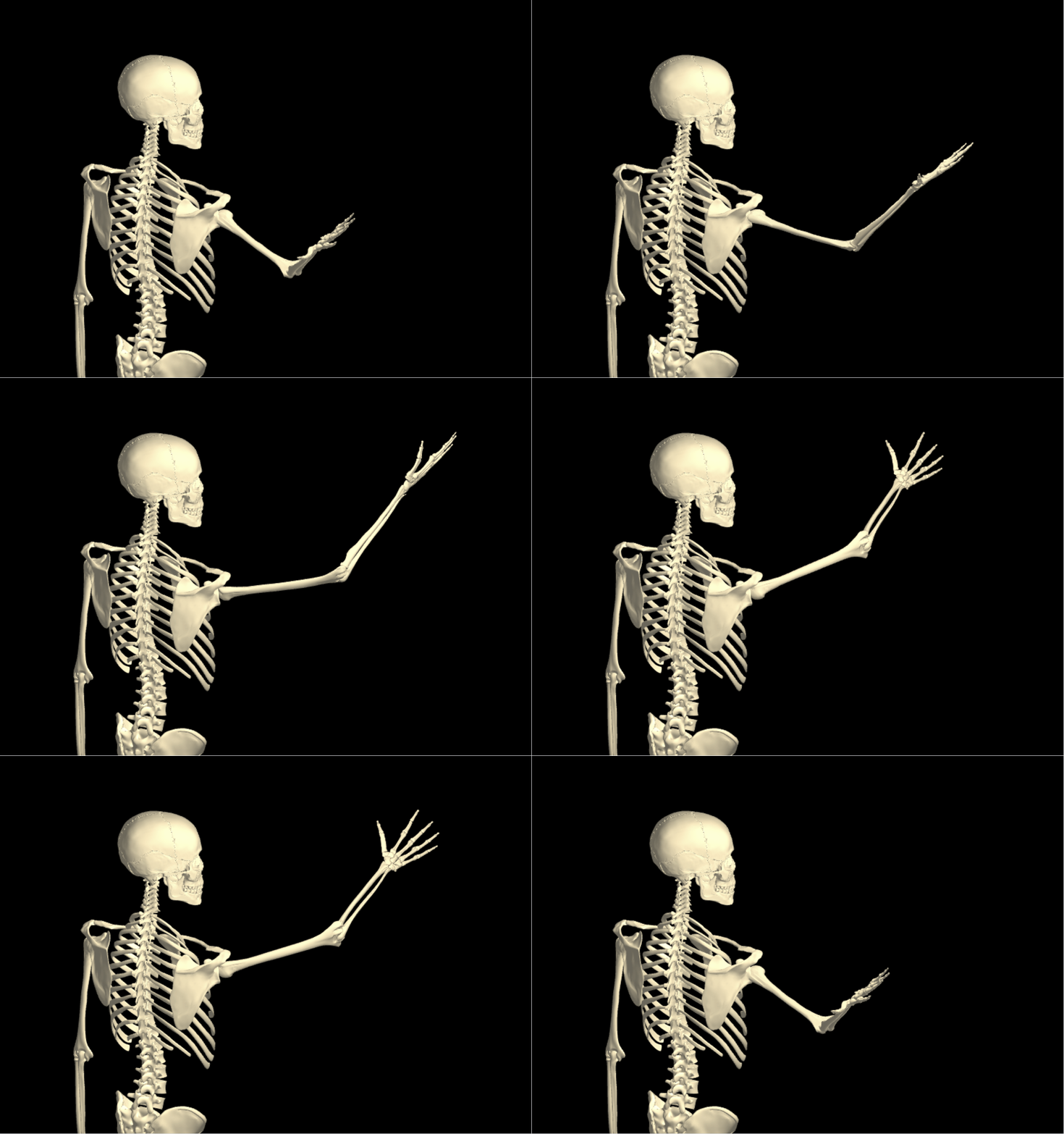
Externally rotate while extending your shoulder, and the natural follow-through will be supination of the forearm:
(animations made with Kinebody Pro)
So here are the groupings for power:
- Internal Shoulder Rotation, Shoulder Flexion, Radioulnar Pronation
- External Shoulder Rotation, Shoulder Extension, Radioulnar Supination
Now I throw some literature at you to demonstrate just how much racket head speed in one-handed power strokes comes from these rotational DoF:
- Tennis
- Badminton
- Squash
A couple of patterns emerge as we inspect these.
- Where measurements are available, the three degrees of freedom we are paying attention to contribute 58% to 83% of total force generation!
- With less time/space for preparation and a lighter racket, pronation or supination contributes a larger proportion of power generation
- Any sort of overhead motion requires abduction, to lift the arm and racket
- Naturally (for a righty), forehand strokes use counterclockwise rotation (ISR, Flexion, Pronation) and backhand strokes use clockwise rotation around the core (ESR, Extension, Supination)
Ok boomer, and?
To restate:
- Explicit kinematic knowledge helps adult racket sport learners
- The racket arm has seven DoF, and you know what they are
- Shoulder Rotation, Shoulder Flexion/Extension, and Radioulnar Pronation/Supination are the primary racket sport power generators
And to translate coach...
"Use your body and keep your arm loose!" -> allow proximal to distal sequencing to happen through the shoulder.
"The serve is like throwing the ball up!" -> like throwing, the serve involves internal shoulder rotation into pronation.
"The defensive forehand is more about the wrist!" (squash) -> with less prep time, emphasize power generation from pronation.
What about the other four degrees of motion? They're important too, but primarily control setup, positioning, and precision. We'll see if I ever get around to writing about them...
Inspired by A Thread of Order, Lock and Roll Tennis, http://www.squashgame.info/
Steenbergen B, et al. Does implicit motor learning lead to greater automatization of motor skills compared to explicit motor learning? A systematic review. PLoS ONE. 2018. https://pmc.ncbi.nlm.nih.gov/articles/PMC6124806/↩
Carson HJ, Collins D. An Explicit Look at Implicit Learning: an Interrogative Review for Sport Coaching Research and Practice. Int Sport Coach J. 2023. https://www.tandfonline.com/doi/full/10.1080/21640629.2023.2179300↩
Sciascia A, Cromwell R. Kinetic Chain Rehabilitation: A Theoretical Framework. PMC. 2012. https://pmc.ncbi.nlm.nih.gov/articles/PMC3361354/↩
Elliott B, Marshall R, Noffal G. Contributions of upper limb segment rotations during the power serve in tennis. J Appl Biomech. 1995;11:433-442.↩
Elliott B. Biomechanics and tennis. Br J Sports Med. 2006;40(5):392-396. https://pmc.ncbi.nlm.nih.gov/articles/PMC2577481/↩
Fett J, Ulbricht A, Ferrauti A. Kinematics characteristics of key point of interest during tennis serve among tennis players: a systematic review and meta-analysis. Front Sports Act Living. 2024. https://www.frontiersin.org/journals/sports-and-active-living/articles/10.3389/fspor.2024.1432030/full↩
Landlinger J, et al. Evaluation of Upper Limb Joint Contribution to racket Head Speed in Elite Tennis Players Using IMU Sensors. Sensors. 2022;22(3):1283. https://www.mdpi.com/1424-8220/22/3/1283↩
Liu X, Kim W. A Correlational Analysis of Shuttlecock Speed Kinematic Determinants in the Badminton Jump Smash. Appl Sci. 2002. Cited in: https://www.mdpi.com/2076-3417/10/4/1248↩
Badminton Insight. How To Do A Stick Smash In Badminton. https://badminton-insight.com/how-to-do-a-stick-smash-in-badminton/↩
Kwan M, Rasmussen J. Biomechanics in Badminton: A Review. Lupine Publishers. https://lupinepublishers.com/orthopedics-sportsmedicine-journal/fulltext/biomechanics-in-badminton-a-review.ID.000129.php↩
Elliott B, Marshall R, Noffal G. The role of upper limb segment rotations in the development of racket-head speed in the squash forehand. J Sports Sci. 1996;14(2):159-165. https://pubmed.ncbi.nlm.nih.gov/8737323/↩
Balasundaram A, et al. Kinematic characterization of backhand stroke accuracy in squash. PeerJ. 2024. https://pmc.ncbi.nlm.nih.gov/articles/PMC11493072/↩